
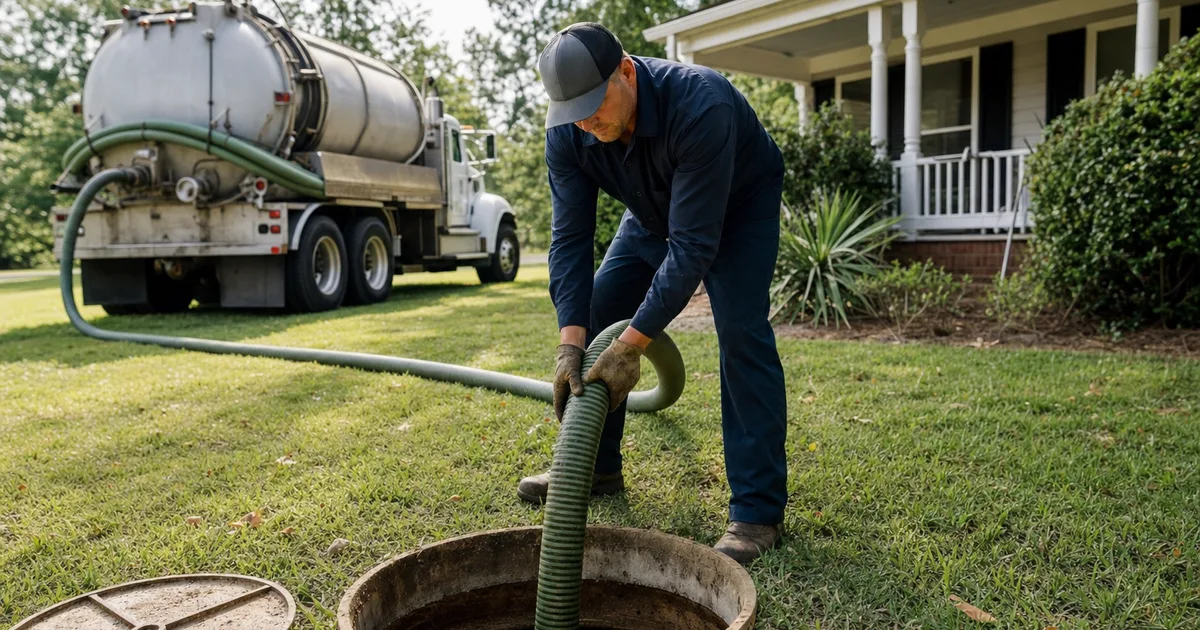
Drainage planning for a new home focuses on what happens to water before it enters your system. Septic maintenance is about what happens after, and that side of the picture gets far less attention until something goes wrong. For homeowners in Fairhope, AL and across Baldwin County, the underground work your septic system does every day is easy to ignore right up until it becomes impossible to ignore. Baldwin County’s clay-heavy soils and heavy summer rainfall put particular stress on septic systems throughout this area, which is something our team at P&C Septic Solutions, based in Daphne, AL, sees firsthand on every service call. We want to give you a clear, practical picture of what septic pumping and maintenance Fairhope, AL actually involves.
Septic pumping and maintenance in Fairhope, AL typically means having your tank pumped every three to five years, with the exact interval depending on household size, tank capacity, and water usage habits. A licensed technician removes accumulated solids, inspects the tank and components, and checks the drain field for signs of stress. The full service visit usually takes one to two hours.
Key Takeaways
- Most Fairhope households should schedule septic pumping every three to five years, but summer guest traffic and high water use can shorten that window.
- Baldwin County’s clay-heavy soils create specific drain field stress that makes regular maintenance more important here than in sandier regions.
- A proper maintenance visit includes more than pumping, covering a full inspection of the tank, inlet and outlet baffles, lids, and the condition of the drain field.
- Slow drains, gurgling pipes, and wet spots near the tank are early warning signs that a system is overdue for service.
- Skipping routine pumping is the single most common reason septic systems fail prematurely, and repairs cost significantly more than maintenance.
What Septic Pumping and Maintenance in Fairhope, AL Actually Includes
A lot of homeowners think of septic pumping as a simple vacuum truck visit, and while the truck is part of it, a thorough maintenance appointment covers considerably more ground. Our technicians start by locating and uncovering the access lids, which on older Fairhope properties are sometimes buried under several inches of soil. Once open, we assess the scum layer at the top of the tank and the sludge layer at the bottom. The combined depth of those two layers tells us how urgently the tank needs to be pumped and whether the system has been pushed harder than normal.
After pumping, we inspect the inlet and outlet baffles, which are the components that prevent solids from flowing out toward the drain field. Cracked or missing baffles are one of the most common findings on systems that haven’t been serviced in several years. We also check the condition of the tank itself for cracks, root intrusion, and lid integrity. If you have a pump system, that equipment gets checked as well. For a deeper look at how all these components connect, our post on How Septic Systems Work and Why Regular Maintenance Matters covers the fundamentals in detail.
The drain field inspection is the final piece. We look for soft or saturated ground above the field lines, unusual odors at the surface, and any vegetation patterns that suggest effluent is pooling where it shouldn’t be. Finding a problem at this stage during routine maintenance is a very different situation from finding it after a backup has already occurred.
How Does Baldwin County’s Soil Affect Septic Systems in Fairhope?
Fairhope sits on a bluff above Mobile Bay, and while the views are exceptional, the soil profile underneath many properties is not particularly forgiving for septic systems. Much of Baldwin County has a mix of sandy topsoil over denser clay subsoil, and that clay layer limits how quickly treated effluent can percolate away from drain field lines. When a tank goes too long without pumping and excess solids reach the field, that already-limited percolation capacity gets further reduced. Recovery is slow and sometimes impossible without significant repair work.
The seasonal rainfall pattern here compounds this. July in coastal Alabama typically brings daily afternoon thunderstorms that saturate the ground quickly. A drain field that is already stressed by a full tank has almost no capacity to handle the additional soil moisture. This is one of the main reasons we see more urgent calls for septic pumping and maintenance Fairhope, AL in midsummer than at almost any other time of year. The system isn’t failing because of the rain alone, it’s failing because the rain arrived when the system had no margin left.
If your property also has drainage challenges beyond the septic system, our post on Drain Field Installation in Daphne, AL: What the Soil Here Actually Demands explains how soil conditions across this region shape the design and maintenance requirements of drain fields specifically.
How Do You Know When Your Fairhope Septic System Needs Service?
The most reliable answer is: before you notice anything at all. By the time a septic system is producing visible or odor-related symptoms, it has already been under stress for some time. That said, there are specific signs that tell you a service call should happen soon rather than at the next scheduled interval.
Slow drains throughout the house, not just in one fixture, are a meaningful signal. A single slow drain usually points to a localized clog, but when multiple fixtures drain slowly at the same time, the tank is often the source. Gurgling sounds in toilets or drains after flushing are another indicator. If you notice a persistently wet or unusually green patch of grass directly above where your tank or drain field is located, that deserves immediate attention.
Summer is a particularly high-risk period for Fairhope households that host guests. A home that normally runs two occupants can effectively double its daily water load during a week of family visits. That kind of sudden surge moves solids toward the outlet faster than the system is designed to handle. If your last pump-out was more than three years ago and you have a busy summer ahead, scheduling service before the guests arrive is the straightforward move.
For a more detailed breakdown of timing and frequency, our post on When Should You Pump Your Septic Tank? walks through the variables that affect your specific schedule.
What to Expect on the Day of Service
Our team arrives with the vacuum truck and any hand tools needed to access the lids. If the lids aren’t already visible at grade, plan for a few minutes of locating and uncovering them. We ask that the area around the tank be accessible and that any vehicles or equipment not be parked over the tank or field lines. The pumping itself takes roughly 20 to 30 minutes for a standard 1,000-gallon tank. The full inspection, documentation, and any minor adjustments bring the total visit to around one to two hours.
After the visit, we walk through our findings with you. If we see anything that needs follow-up, a baffle replacement, a lid upgrade, or a more thorough look at the drain field, we explain it in plain terms and give you a clear picture of urgency. Not every finding is an emergency, and we won’t tell you it is when it isn’t.
Septic pumping and maintenance Fairhope, AL is straightforward when it’s done on schedule. The systems that cause the most trouble are almost always the ones that were left too long between service visits. With July storms already cycling through the area and household usage at its annual peak, mid-year is one of the better times on the calendar to make sure your tank has the capacity to handle what’s coming. You can reach our team through our contact page to schedule a visit.
Frequently Asked Questions
How often should I schedule septic pumping and maintenance in Fairhope, AL?
For most households in Fairhope, a pumping interval of three to five years is the standard recommendation. Homes with more occupants, garbage disposals, or high water usage should lean toward the shorter end of that range. Baldwin County’s clay-heavy soils make it especially important not to push the interval, since drain fields here have less natural recovery capacity than those in sandier regions.
Can I use my septic system normally right after it’s been pumped?
Yes, the system is fully operational immediately after pumping. There’s no waiting period required. We do recommend avoiding extremely high water use, such as multiple loads of laundry back to back, for the first day or two to give the bacterial population in the tank time to re-establish at healthy levels.
What happens if I skip routine maintenance for too long?
When a tank goes too long without pumping, accumulated solids begin migrating out toward the drain field. Once solids reach the field lines, they clog the soil and reduce the field’s ability to process effluent. This can lead to drain field failure, which is a significantly more expensive repair than routine pumping and maintenance. In some cases, a failed field requires full replacement.
Does the age of my Fairhope home affect how often I need service?
It can. Older homes in the Fairhope area sometimes have smaller tanks that were sized for fewer occupants or lower water use than modern households generate. If your home was built before the 1990s and you haven’t had the tank inspected recently, confirming the tank capacity and current condition is a good idea. Our team can assess this during a standard maintenance visit.