
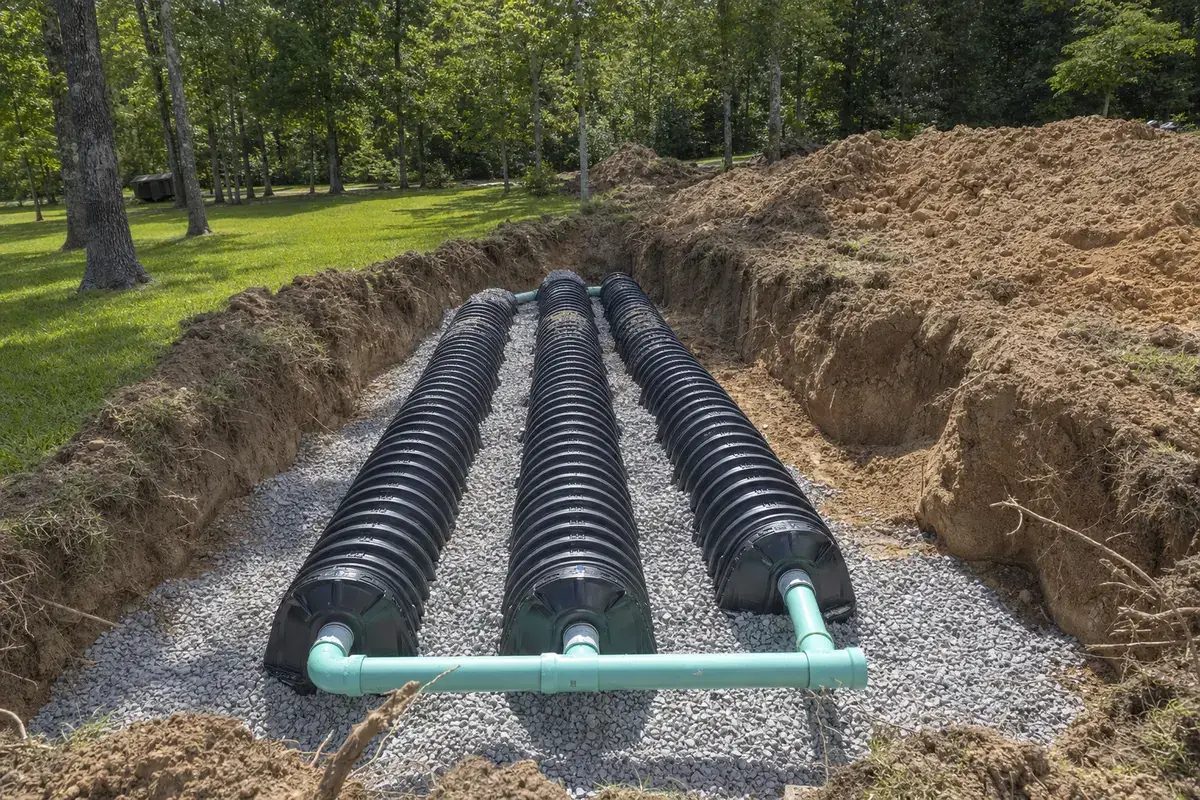
It usually starts with something else. A homeowner calls us about a slow-draining system or a tank that keeps backing up, and after we dig into the diagnostics, the real problem turns out to be further down the line than they expected. The tank itself might be fine. The pump might be working. But the drain field, the part of the system that actually disperses treated wastewater into the ground, has stopped doing its job. That conversation happens more in August than any other month, and it happens even more often for properties in and around Foley, where the soils and seasonal water table create conditions that accelerate drain field stress. Our company is based in Daphne, AL, where the same Gulf Coast clay and sand profiles that define Baldwin County’s drainage challenges begin, and we see those same conditions intensify as you move south toward Foley. If you have been told you need drain field installation and repair Foley, AL, the timing is not a coincidence.
Drain field installation and repair in Foley, AL involves assessing, restoring, or replacing the network of perforated pipes and surrounding soil that disperses effluent from your septic tank. Foley’s high water table, especially in summer, limits soil absorption capacity, which leads to surfacing effluent, soggy ground near the drain field, and sewage odors. Repair may involve targeted fixes, while full installation replaces the failed system with a properly sized and permitted drain field.
Key Takeaways
- Foley’s water table rises significantly in summer, reducing the soil’s ability to absorb effluent and accelerating drain field failure.
- Signs of drain field failure include slow drains, sewage odors, wet or spongy ground above the field, and sewage backing up into the home.
- Not every failing drain field needs full replacement; targeted repairs can restore function if the damage is caught early enough.
- Advanced septic systems are sometimes required in Foley when standard drain fields cannot meet soil or setback requirements.
- Proper drainage and grading around the drain field area can significantly extend the life of a new or repaired system.
What Foley’s Soils and Water Table Actually Do to a Drain Field
Foley sits in the lower end of Baldwin County, and the ground here behaves differently than it does even a few miles north. The soils trend toward fine sand and loamy profiles that can drain reasonably well under dry conditions, but that same soil structure becomes nearly saturated during the wet season. By August, after months of Gulf Coast thunderstorms stacking on top of each other, the water table in many Foley neighborhoods sits close enough to the surface that drain fields have almost no vertical separation from groundwater. That separation is what allows the soil to treat and absorb effluent safely. When it disappears, the field fails.
We see this pattern play out regularly along areas near the Foley Beach Express corridor and in subdivisions south of County Road 20, where lots tend to be flatter and drainage has fewer natural outlets. Properties that function perfectly well in February can show clear signs of drain field stress by mid-July. The issue is not always a broken pipe or a collapsed trench. Sometimes the field itself is structurally intact but hydrologically overwhelmed. Understanding the difference matters a great deal when deciding between repair and full replacement, and it is one of the reasons a proper site evaluation is the first step in any drain field installation and repair conversation.
How Do You Know If Your Drain Field Is Failing?
The symptoms are usually unmistakable once you know what to look for. The most obvious sign is wet or spongy ground directly above the drain field area, sometimes accompanied by a sewage odor that gets stronger after rain. Inside the home, you might notice that toilets and drains are slow even after the tank has been recently pumped. In more advanced cases, sewage backs up into the lowest fixtures in the house. None of these symptoms should be dismissed as temporary, especially in summer when the conditions driving the failure are at their worst.
What complicates diagnosis is that some of these symptoms can also point to a full tank, a failing pump, or a clogged inlet baffle. That is why we always recommend a full system inspection before assuming the drain field is the problem. Our team checks the tank condition, the effluent levels, and the field itself before recommending a course of action. If you have already read our post on septic pump repair and installation in Foley, AL, you know that pump issues can mimic drain field symptoms, so ruling those out first saves time and money. Our septic pumping and maintenance service is often the starting point for that evaluation.
What drain field installation and repair Foley, AL actually involves on a typical property
If a repair is viable, we typically address the specific failure point rather than replacing the entire field. This might mean clearing biomat buildup from perforated pipes, correcting a crushed or offset lateral, or regrading the surrounding area to redirect surface water away from the field. In some cases, French drains or hard pipe drainage installed around the perimeter of the drain field area can relieve enough hydraulic pressure to restore function without a full replacement. Our drainage and grading work often pairs directly with drain field repairs for exactly this reason.
When full replacement is necessary, the process involves pulling permits through Baldwin County, conducting a soil evaluation, and designing a new field that meets current setback and sizing requirements. Foley properties that cannot support a conventional drain field due to soil limitations or lot constraints may qualify for an advanced septic system, which uses additional treatment stages to reduce the effluent load on the soil. Our post on how to know if your property needs an advanced septic system covers the criteria in more detail. The excavation involved in a full installation is significant, and we handle it in-house so the work is coordinated from start to finish.
Pricing for drain field installation and repair Foley, AL depends heavily on the size of the existing system, the extent of the damage, soil conditions on the specific lot, and what drainage improvements may be needed alongside the septic work. We do not publish flat rates because no two properties are the same. A site visit and custom estimate is the only accurate way to get a real number.
Frequently Asked Questions
How long does a drain field typically last in Foley, AL?
A properly installed drain field in Foley can last 20 to 30 years under normal conditions, but that lifespan shortens significantly when the system is undersized, when the water table is consistently high, or when the tank is not pumped on a regular schedule. Properties in lower-lying areas near Foley’s southern subdivisions tend to see stress earlier than those on slightly elevated ground. Routine septic maintenance is the single most effective way to extend drain field life.
Can a failing drain field be repaired, or does it always need full replacement?
Not every failing drain field requires full replacement. If the damage is caught early and involves a specific mechanical failure like a crushed pipe or localized biomat buildup, targeted repairs can restore the system. However, if the field has failed due to long-term hydraulic overload or the soil structure has been permanently compromised, replacement is usually the more cost-effective long-term solution. Our team evaluates both options before making a recommendation.
Does Foley’s water table affect where a new drain field can be installed?
Yes, significantly. Baldwin County requires a minimum vertical separation between the bottom of the drain field and the seasonal high water table, and in parts of Foley that separation can be difficult to achieve on standard lots. When it cannot be met with a conventional system, an advanced septic system with elevated or mound-style components may be required. A soil evaluation conducted during the permitting process determines what is feasible on a given property.
How does surface drainage around the drain field affect its performance?
Poor surface drainage is one of the most overlooked contributors to premature drain field installation and repair Foley, AL calls we receive. When stormwater pools over or flows toward the drain field area, it saturates the soil and eliminates the absorption capacity the system depends on. Correcting the grading and drainage around the field is often part of our repair scope, and in many cases it makes the difference between a system that lasts and one that fails again within a few years.
Foley is growing fast, and a lot of that growth is happening on land that was not originally developed because the drainage was difficult. As more homes go in across the Foley area, drain field installation and repair Foley, AL is only going to become a more common need. The ground here has a memory, and it does not forget a wet summer. If your system is showing signs of stress right now, August is exactly the wrong time to wait.
Reach out to our team through our contact page to schedule an evaluation. We work across Daphne, Foley, Fairhope, Loxley, and the surrounding Baldwin County communities, and we know what the soil here actually demands.