
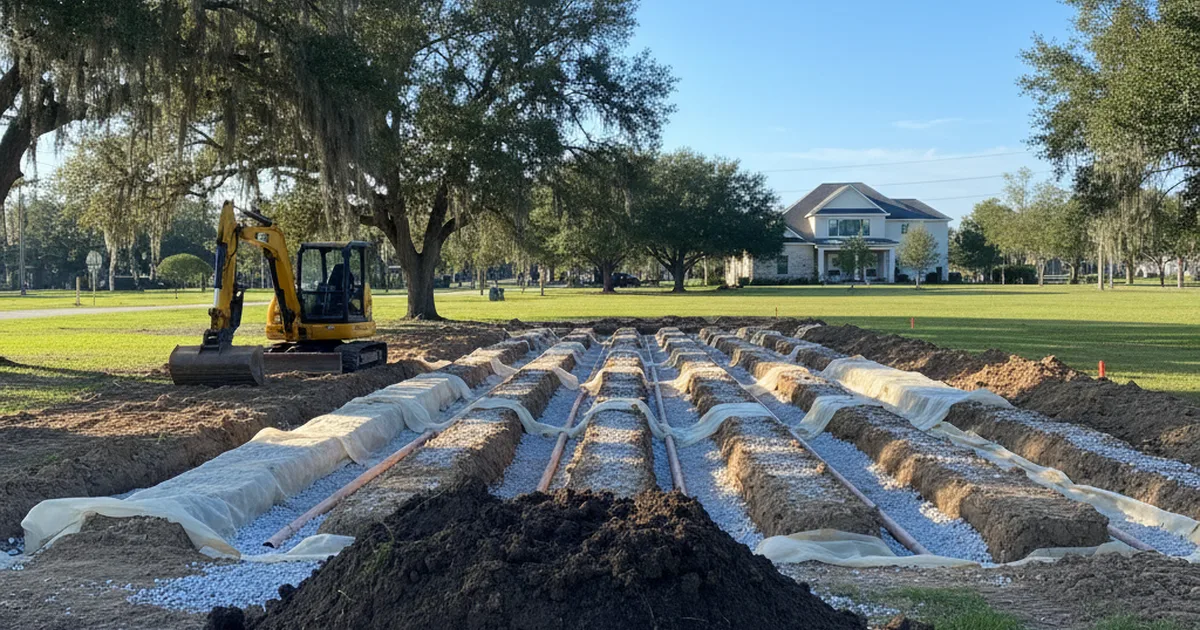
Dig down about eighteen inches in most of Daphne, AL and you already know what you’re dealing with. That reddish-brown clay layer sitting beneath a thin band of sandy topsoil tells the whole story. After a good April rain, which we’ve had plenty of this month, that clay holds water like a bowl. It doesn’t drain. It doesn’t forgive. And if your drain field was installed without accounting for it, you’re going to feel the consequences sooner than you’d like. Drain field installation in Daphne, AL isn’t a generic process you can lift from a textbook. The ground here has its own rules, and the work has to follow them.
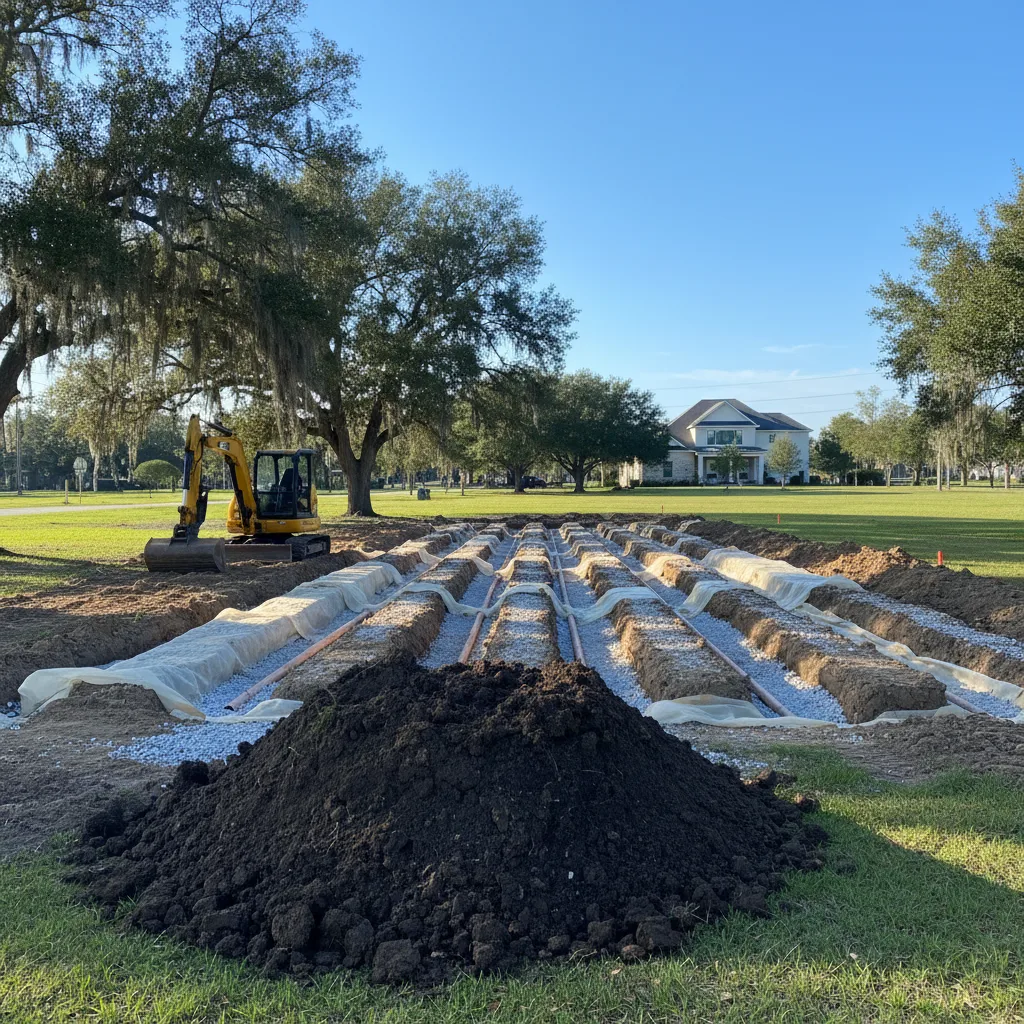
Why Daphne’s Soil Makes Drain Field Installation Different
Most of Baldwin County sits on a mix of sandy loam and clay-heavy subsoil, but Daphne’s topography adds another layer of complexity. The city’s terrain rolls and drops toward Mobile Bay, which means elevation changes of just a few feet can shift your soil profile significantly. Properties near the Jubilee Parkway corridor tend to sit lower, with water tables that climb fast after heavy spring rains. Properties up toward the US-98 corridor and into the Lake Forest subdivision often deal with compacted red clay that barely passes a percolation test without site prep work.
Before any drain field goes in the ground, we run a soil evaluation and percolation test. That test tells us how quickly water moves through your specific soil, and in Daphne, the results vary more than people expect. A lot of homeowners assume their lot will pass easily because the yard looks dry. But dry grass in April doesn’t mean the subsurface is draining. It means the clay is holding moisture below the root zone while the surface dries out in the sun. We’ve seen that scenario lead to failed drain fields that were installed by contractors who skipped the site analysis.
Our drain field installation and repair services are built around what the soil actually shows us, not what a standard spec sheet assumes. That’s the difference between a system that lasts twenty years and one that backs up in three.
What Drain Field Installation in Daphne, AL Actually Involves
The process starts well before any equipment rolls onto your property. Baldwin County has its own permitting requirements for septic and drain field work, and we handle that paperwork as part of the job. Once permits are cleared, we assess the site layout, identify the best placement for the leach field relative to your tank, your home’s footprint, and any existing drainage patterns on the lot.
Excavation comes next. Depending on your soil results, we may be working with a conventional trench system, or we may need to go a different direction entirely. If your water table is too high or your soil fails to perc adequately, a conventional drain field simply isn’t an option. That’s where advanced septic systems, including mound systems, come into the picture. Mound systems elevate the leach field above the natural ground surface, which gives effluent the treatment distance it needs even when the native soil can’t provide it. We’ve installed a number of these on lower-lying lots near Daphne’s eastern neighborhoods, where the proximity to wetland buffers limits what a conventional system can do.
The excavation work itself has to be done carefully here. Disturbing the surrounding soil too aggressively can compromise the percolation zone you’re trying to protect. We also pay close attention to how the grading around the new field will affect surface water movement. Poor grading is one of the most common reasons drain fields fail prematurely, and it’s entirely preventable. Our drainage and grading services are often part of the same project scope when we’re doing new drain field work.
Connecting the Drain Field to the Rest of Your Septic System
A drain field doesn’t function in isolation. It’s the final stage of a system that starts at your home’s plumbing and runs through your septic tank before reaching the leach field. If any part of that chain is undersized, damaged, or poorly positioned, the drain field takes the hit. We’ve seen tanks that were never properly sized for the home’s usage, and the drain field absorbed years of overload until it gave out.
When we’re doing drain field installation in Daphne, AL, we always evaluate the condition of the existing tank and the pump system if one is present. A failing pump can flood a new drain field just as quickly as a bad one can ruin an old one. Getting the whole system right at once saves a significant amount of money compared to addressing each component separately over time. Our blog post on septic tank installation in Daphne covers the full system context if you want a broader picture of how these components work together.
After Installation: Protecting Your Drain Field Long-Term
Once a new drain field is in and the site is restored, the work shifts to protecting what’s been built. That means keeping heavy equipment and vehicles off the field area, managing what goes down your drains, and staying on top of regular septic pumping and maintenance. A well-maintained system in Daphne’s climate can perform reliably for decades. A neglected one won’t make it ten years regardless of how well it was installed.
We also recommend restoring the surface over the drain field thoughtfully. Shallow-rooted grass is the right choice, and we can help with sod installation once the ground has settled. Deep-rooted plants, trees, and heavy mulch beds don’t belong anywhere near a leach field. If you’re unsure what to put back over the area, our plantings and softscapes team can walk you through options that protect the system while keeping the yard looking right.
If you’re dealing with a failing field, planning a new build near the Jubilee Parkway area, or just starting to notice the signs described in our septic warning signs guide, reach out to us through our contact page and we’ll take a look at what your specific site needs. Drain field installation in Daphne, AL is something we’ve done enough times in enough different soil conditions around this city that we’re not guessing when we show up. We know what we’re walking into before the first shovel breaks ground.