
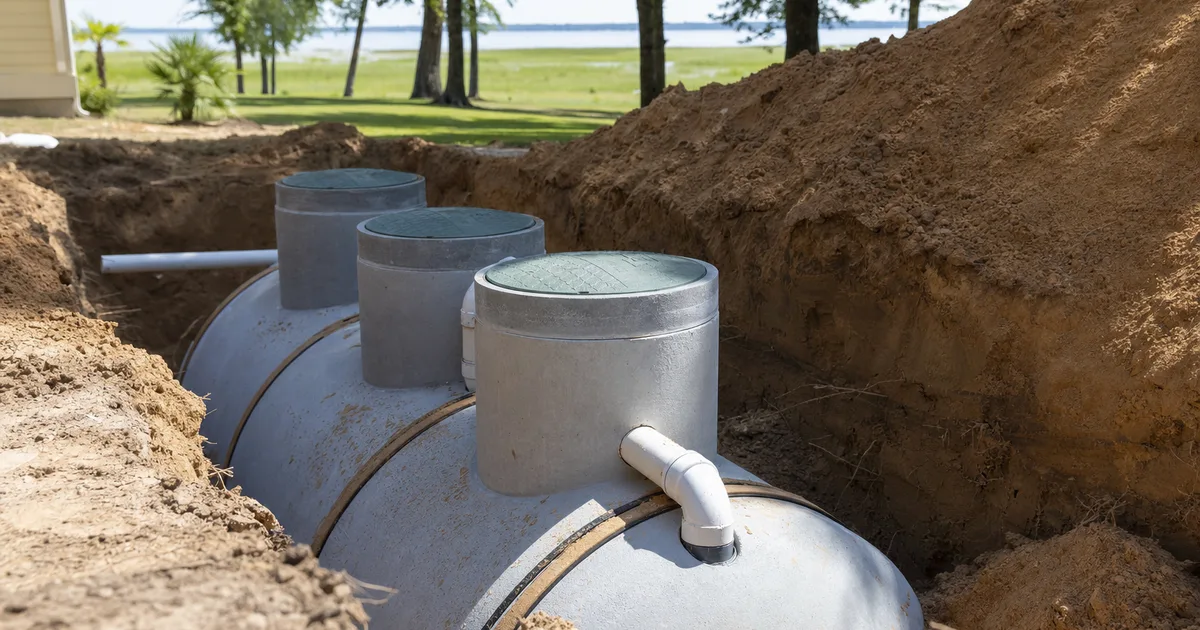
It usually starts with a culvert. A homeowner in Daphne, AL calls us about standing water near their driveway or a culvert that’s not moving water the way it should, and while we’re walking the property, something else comes up. There’s a soft, saturated patch in the yard. A smell near the back fence line. A drain that’s been sluggish for months. Daphne sits in a stretch of Baldwin County where the combination of clay-heavy soils, a high water table near Mobile Bay, and heavy summer rainfall puts real pressure on residential septic systems year-round. What started as a drainage conversation turns into a closer look at the septic system, and more often than not, we find a tank that’s either failing or was never properly installed for the lot. That’s how a lot of families in this area first discover they need to think seriously about alabama septic tanks installation daphne. The two services are more connected than most people expect, and understanding that connection helps you make better decisions about your property.
Why Soil and Site Conditions in Daphne Drive Every Installation Decision
Baldwin County soil is not uniform, and Daphne sits in a stretch of the Eastern Shore where conditions shift considerably from one street to the next. In some neighborhoods closer to Mobile Bay, you’re dealing with high clay content that drains poorly and holds moisture for extended periods. Move a few miles inland toward the newer developments off Highway 181, and the soil profile changes, sometimes dramatically. Sandy loam drains faster but may require different tank sizing or placement to stay compliant with state standards.
Before any alabama septic tanks installation daphne project begins, we conduct a percolation test and soil evaluation. This is required by the Alabama Department of Public Health before a permit is issued. The perc test measures how quickly water moves through the soil at the proposed drain field location. That data directly determines what type of system gets installed, where the tank sits, and how the drain field is laid out. If you’ve read our earlier post on drain field installation in Daphne, you already know how much the soil here shapes the outcome. The tank itself is only part of the equation.
Lot size matters too. Daphne has a mix of older established neighborhoods with smaller parcels and newer subdivisions with more room to work. Minimum setback distances from property lines, wells, and structures are fixed by state code, so we’re always mapping the available footprint before we recommend a system size or configuration.
What the Alabama Septic Tanks Installation Daphne Process Actually Involves
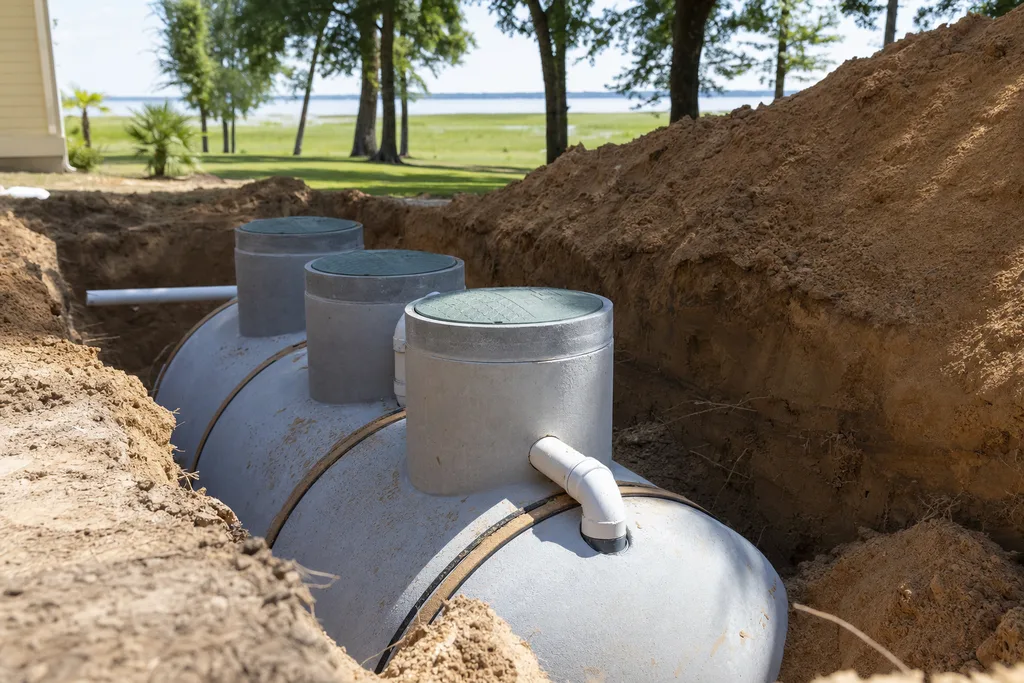
Once the site evaluation is complete and the permit is pulled from the Baldwin County Health Department, the installation sequence follows a clear order. We start with excavation, opening the tank pit and drain field trenches to the specified depths. For a standard gravity-fed system, the tank is set in the pit, leveled, and connected to the home’s main sewer line. Inlet and outlet baffles are inspected and confirmed before backfill begins.
The drain field trenches are then lined with gravel and perforated pipe, sloped to distribute effluent evenly across the absorption area. Inspection ports are installed at key points so the system can be monitored over time. After the health department inspector signs off, the trenches are backfilled and the surface is rough-graded.
For properties where soil conditions don’t support a conventional gravity system, we install advanced septic systems that use pumps and pressure distribution to manage effluent more precisely. These systems require a pump and control panel, which adds complexity but gives the system far more flexibility on challenging lots. The timeline for a standard alabama septic tanks installation daphne project runs three to five days from excavation to final grading, assuming no permitting delays and no unexpected soil issues mid-dig.
How to Know If Your Property Needs a New Installation Rather Than a Repair
This is a question we get often, and the honest answer is that it depends on what’s actually failing. A tank with a cracked baffle or a broken lid doesn’t need to be replaced, it needs targeted repairs. But a tank that’s structurally compromised, undersized for the home’s current occupancy, or sitting over a drain field that has completely failed, that’s a different situation. Our post on septic tank repairs in Daphne walks through the diagnostic side in more detail if you’re trying to sort out which category you’re in.
Signs that point toward full replacement rather than repair include persistent drain field saturation that doesn’t resolve after pumping, sewage surfacing in the yard, multiple system failures in a short period, or a system that was installed before current code requirements and can’t be brought into compliance through modification alone. If your home was built in the 1970s or 1980s and has never had a full system evaluation, scheduling one is a smart move. Alabama septic tanks installation daphne standards have evolved considerably, and older systems often don’t meet current setback or capacity requirements.
What Happens to Your Yard After Installation
A full installation leaves the yard disturbed, there’s no way around it. Excavation for a standard system typically affects a significant portion of the backyard, and the soil that comes back up is looser and more uneven than what was there before. We do final grading as part of every installation, but the surface needs time to settle before any permanent landscaping goes in.
Depending on the time of year and how much disruption occurred, we often recommend waiting four to six weeks before laying sod over the affected area. In May, with soil temperatures already warm across Baldwin County, grass establishes quickly once the ground stabilizes. We can also help with plantings and softscapes around the perimeter of the disturbed area, and a yard cleanup to address debris left from the excavation process. The goal is to leave the property looking like work was done properly, not just done.
If you’re planning a new build or major renovation in Daphne and haven’t yet addressed the septic side, now is the right time to get the evaluation scheduled. Summer rain in Baldwin County arrives fast, and saturated ground makes excavation harder and more expensive. Getting ahead of that window is one of the most practical things a homeowner can do before the wet season settles in.
For more information about our full range of septic services, visit our septic services page, or reach out to our team to schedule a site evaluation.
FAQ: Alabama Septic Tank Installation in Daphne
When should homeowners start planning this project?
Start planning before the problem is urgent. That gives the crew time to evaluate soil, drainage, access, materials, and scheduling instead of rushing the work.
Planning ahead also means budgeting ahead. Our septic tank installation cost guide for Alabama covers the typical range and why quotes differ.
What affects the final recommendation?
Property layout, grade, drainage, soil conditions, existing hardscapes, plantings, traffic patterns, and the owner’s long-term goals all shape the right approach.
Why hire a local professional?
A local team understands the climate, soil, permitting habits, material performance, and seasonal timing that can change how the work should be designed and installed.