
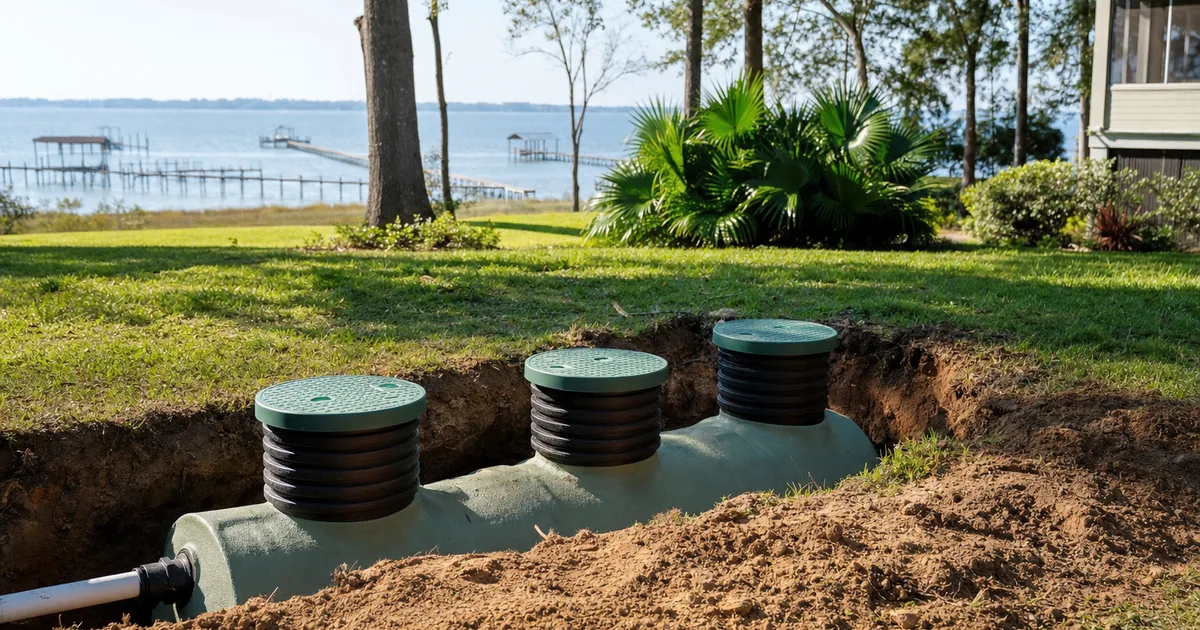
It often starts with a culvert. A homeowner in Daphne, AL calls us about standing water near their driveway crossing, and while we are walking the property, we notice something else: soft ground near the drain field, a faint odor after heavy rain, or grass that is suspiciously green and wet in one concentrated patch. Baldwin County’s combination of dense clay soils, shallow water tables, and low-lying coastal terrain makes these discoveries more common than most homeowners expect. These are not culvert problems. These are septic problems, and they are often signs that the existing system was never the right fit for the site to begin with. For homeowners in Fairhope and across Baldwin County, this is where the conversation about advanced septic systems in Fairhope, AL actually begins, not with a planned upgrade, but with a problem that a conventional system cannot solve.
What Advanced Septic Systems Actually Are
A conventional septic system works through gravity. Wastewater flows from the home into a tank, solids settle, and the liquid effluent drains into a leach field where the soil filters and absorbs it. That process works well on the right lot. But the right lot requires adequate soil depth, appropriate percolation rates, and enough separation from the water table. In Baldwin County, those conditions are frequently absent. The soils around Fairhope range from dense red clay to fine sandy loam, and the water table in lower-lying areas sits close enough to the surface that a conventional drain field cannot maintain the treatment distance required by Alabama Department of Public Health onsite sewage regulations.
Advanced septic systems are engineered responses to those limitations. They treat wastewater to a higher standard before it ever reaches the soil, which means they can operate in conditions where a conventional system would fail or be denied a permit outright. The most common types we install in this area include aerobic treatment units, mound systems, and drip irrigation systems. Each one addresses a different site constraint, and the right choice depends on the specific results of your soil evaluation and site survey. Our article on drain field installation goes deeper on how soil conditions drive these decisions locally.
Why Fairhope Properties Often Require Advanced Septic Systems
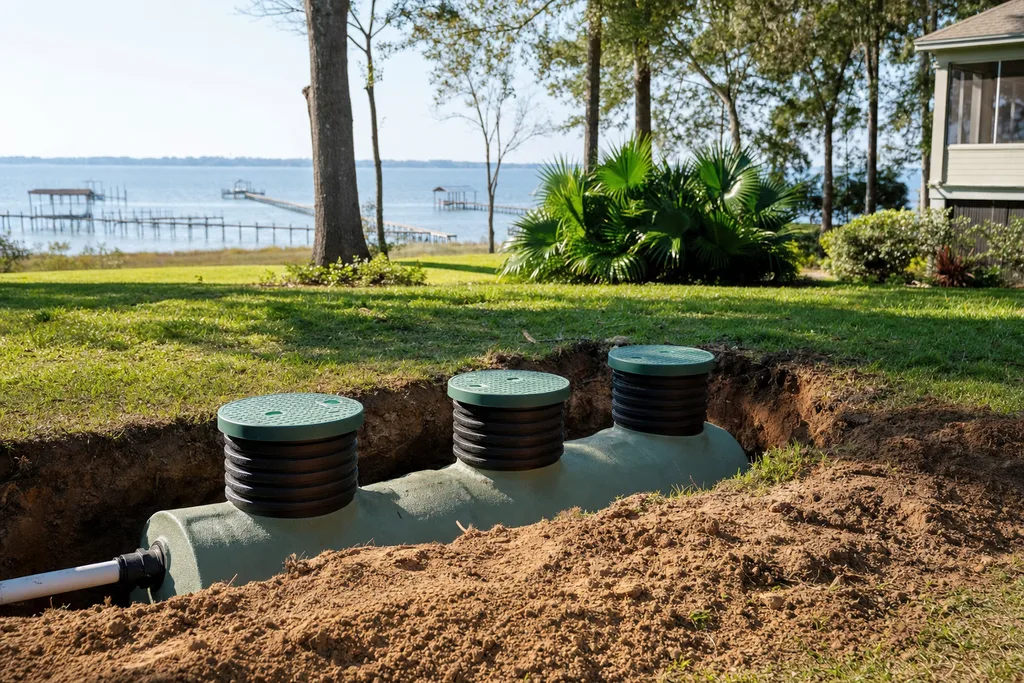
Fairhope sits on a bluff above Mobile Bay, and that geography creates a layered soil profile that varies significantly even within a single neighborhood. Properties near the bay or along the lower sections of the Greeno Road corridor can have seasonally high water tables that push effluent back toward the surface. Properties on the bluff itself may have shallow bedrock or tight clay layers that prevent adequate percolation. Neither condition supports a standard leach field, and both are common enough that we evaluate for them on nearly every site assessment we conduct in the area.
The regulatory environment adds another layer of complexity. Baldwin County and the Alabama Department of Public Health have specific setback and treatment requirements that often rule out conventional systems on smaller lots or those near wetlands and drainage features. If your property has a culvert, a French drain, or any engineered drainage infrastructure, those features factor into the site evaluation and can affect where a system can legally be placed. This is not bureaucratic friction; it is protection for the aquifer and the bay that the entire region depends on.
What the Installation Process Looks Like
The process for installing advanced septic systems in Fairhope, AL starts well before any equipment arrives on site. We begin with a soil evaluation and site survey, which determines the soil type, percolation rate, seasonal high water table depth, and available area for system placement. That data goes into the permit application with Baldwin County Environmental Health. Permitting timelines vary, but homeowners should plan for two to four weeks before ground is broken.
Once permits are approved, excavation begins. The scope depends on the system type. A mound system requires significant earthwork to build an elevated bed of imported fill soil above the native grade. An aerobic treatment unit requires precise placement of the tank, an air compressor unit, and a spray or drip distribution network. Drip irrigation systems involve laying a network of small-diameter tubing across the designated treatment area, which is then covered and restored. We handle the full scope of that work, including the grading needed to ensure proper drainage away from the system footprint.
After installation, aerobic systems require periodic inspections and maintenance contracts under Alabama regulations. The air compressor, chlorination system, and float switches all need regular service to keep the unit operating within permitted parameters. Our team handles pump installations and repairs as well as ongoing septic pumping and maintenance to keep these systems performing correctly year after year.
How to Recognize When You Need One
The clearest sign is a failed perc test or a permit denial for a conventional system. If you are building on a lot in Fairhope and the soil evaluation comes back with numbers that do not support a standard leach field, an advanced system is not optional; it is the path forward. For homeowners with existing systems, the warning signs are more gradual. Slow drains throughout the house, sewage odors in the yard, wet or unusually green patches over the drain field, and backups after heavy rainfall all suggest the current system is overwhelmed or failing. Our guide on septic warning signs covers these indicators in more detail.
We also see situations where a system that was adequate ten years ago no longer meets current household demand. A home addition, a converted garage apartment, or even a shift in water usage habits can push effluent volume beyond what an older system was sized to handle. In those cases, upgrading to an advanced system is often more cost-effective than attempting to expand a failing conventional one.
Properly designed advanced septic systems in Fairhope, AL are a precision solution for sites with real constraints, and in Baldwin County, those constraints are the rule rather than the exception. June is also a particularly relevant time to address these issues: increased household water use during summer, combined with the region’s afternoon storm patterns, puts existing systems under measurable stress. A system that holds through winter may show its limits by midsummer, and that is the point when a proper evaluation is worth scheduling before a failure forces the issue.
If you are ready to talk through your site’s specific conditions, reach out to our team and we will start with what the soil and the permit process actually require.